
Five things worth knowing first.
Twenty years of planning and design work, distilled. Whether you're building from scratch, extending, or just weighing up a site, these are the things we wish every client understood before they started.
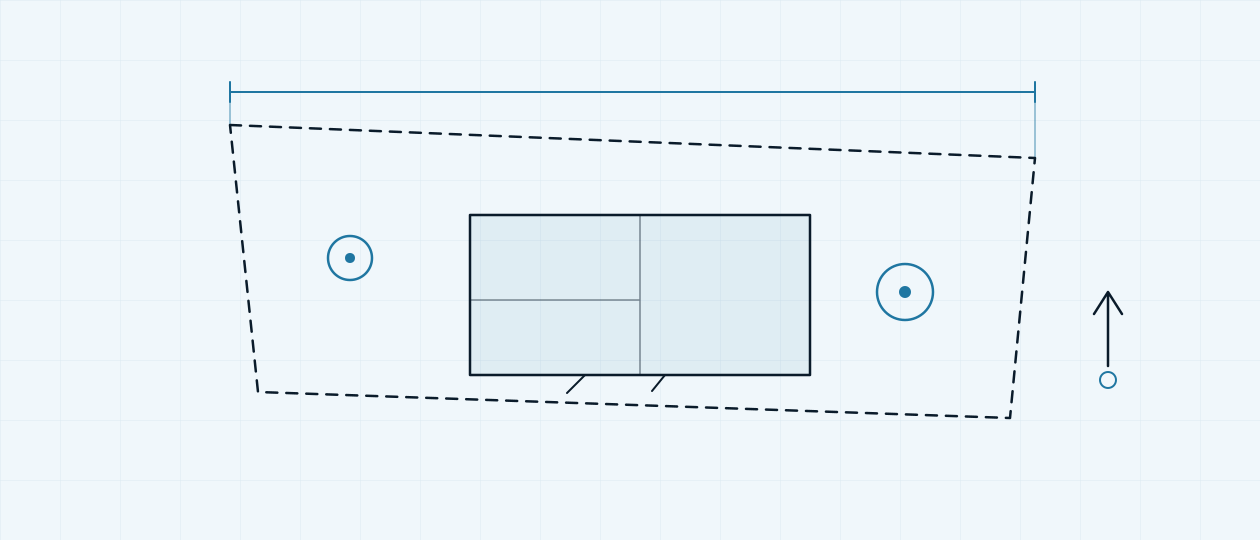
Planning Permission: What's Required?
For anyone about to start the exciting experience of building a first home, or giving an existing home a much-needed extension and makeover, there's a lot to take into account.
First there's the planning process. For a lot of people this can seem daunting, sometimes even off-putting. While planning permission approvals have been increasing nationwide, there's still a set of criteria your proposed house and site must meet for permission to be granted. These are set out in the local authority's county development plan, which tells you how the area is zoned, the design principles you must adopt, and the objectives you need to meet as an applicant.
Zoning is broken into three factors.
A. Areas under strong urban influence
These are locations on the outskirts of cities and major towns. They're very desirable places to build and live. To stop these areas being overrun with one-off houses, councils set stringent objectives that applicants must meet before applying.
To demonstrate a housing need, any of the following should be met:
- The application is made by a long-term landowner, or their son or daughter
- The applicant works the family farm and the house is for their own use
- The applicant works in essential rural activities and needs to live near their place of work
- The application is made by a local rural person who, for family or work reasons, wishes to live in the rural area where they have spent a substantial period of their life (minimum 10 years)
B. Areas with a strong agricultural base
These are locations with a traditionally strong agricultural base, usually areas with a network of smaller rural towns and villages.
To demonstrate a housing need here, any of the following should be met:
- The application is made by a long-term landowner, or their son or daughter, seeking to build their first home on the family land
- The applicant works the family farm and the house is for their own use
- The applicant works in essential rural activities and needs to live near their place of work
- The application is made by a local rural person who, for family or work reasons, wishes to live in the rural area where they have spent a substantial period of their life (minimum 10 years) and is seeking to build their first home there
C. Areas with a structurally weak base
These are areas a council considers under-populated or economically weaker than others in the county. There's little or no applicant criteria to meet here, apart from the standard planning regulations, which are assessed once your application is lodged.
Putting your application together
Once you're satisfied you meet the regulations above, it's time to assemble your planning application. It's made up of:
- A local map, 6 copies
- Site and layout plans, 6 copies
- Plans, elevations and sections of the proposed house, 6 copies
- A site suitability report (percolation test), if required
- A completed local authority planning application form
- Copies of public notices, meaning the newspaper ads and the site notices
- The planning application fee
Planning application fees apply and are set by your local authority. The fee for a new house and the fee for an extension still need to be confirmed against current Irish planning regulations before this page goes live.
Developments exempt from planning permission
The square-metre limits, heights and distances in this section were carried over from the previous danarch.ie site and may be out of date. Every figure marked below must be checked against the current exempted development regulations and confirmed before this page goes live. No old numbers have been hardcoded.
Extensions. A single-storey extension can be built at the rear of a house, up to maximum floor areato confirm square metres.
Terraced or semi-detached houses. The floor area of a two-storey extension cannot exceed maximum floor areato confirm square metres. Any two-storey extension must be at least minimum distanceto confirm metres from any boundary. The extension must not exceed the height of the original house, and must not reduce the garden to less than minimum garden areato confirm square metres.
Garages. You can build a garage as long as it does not extend beyond the front of the existing house and does not exceed maximum heightto confirm metres in height. The maximum size without planning permission is maximum floor areato confirm square metres. As with extensions, building a garage must not reduce the garden to less than minimum garden areato confirm square metres.
Front porch. A porch to the front of the house can be built without planning permission as long as it is no more than maximum floor areato confirm square metres, at least minimum distanceto confirm metres from any public road or footpath, and does not exceed maximum heightto confirm metres in height.
Walls, fences and gates. Walls and fences can be built around your property as long as they do not exceed maximum heightto confirm metres at the front of the house, or maximum heightto confirm metres at the side or rear. Gates can be built or replaced as long as they are no more than maximum heightto confirm metres in height.
If you wish to widen your existing site entrance or build a new one, planning permission will be needed.
Other items that do not require planning permission include chimneys and boiler houses, paths, ponds and patios, and TV aerials.
These are the basics of planning permission requirements. For anything specific to your site, a free consultation is the fastest way to a clear answer.
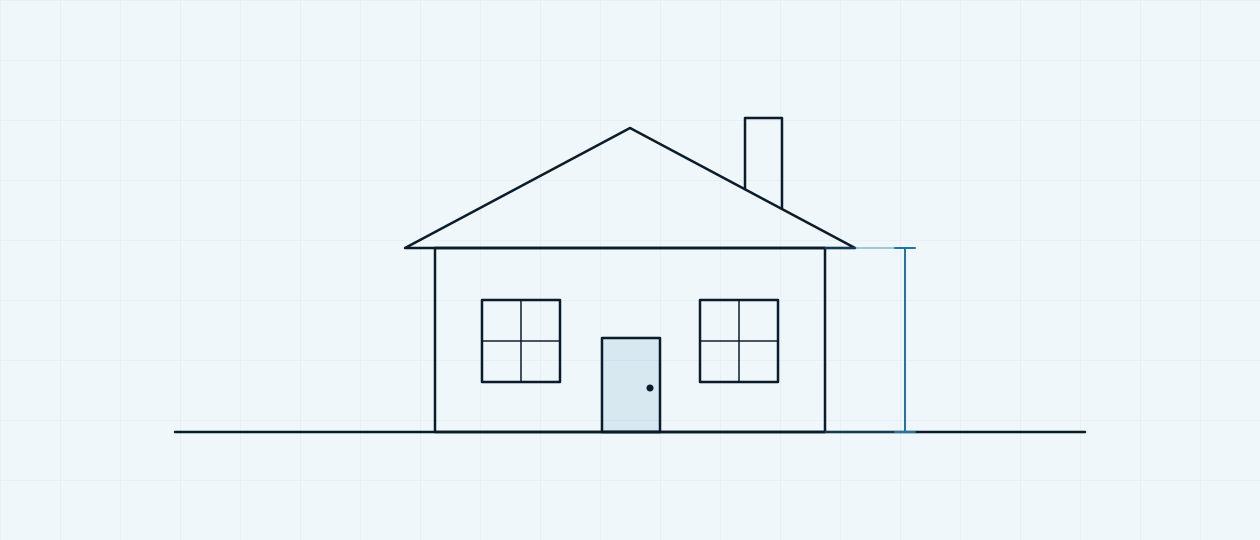
Designing Your Home
Designing your own home can be one of the most fulfilling and rewarding things anyone does in their lifetime. It gives you the chance to get your creative juices flowing. While it's very important to bring in a professional, it's just as important that you, as the future occupiers, take ownership of the project. Once the design stage is complete, the final draft should truly reflect your needs, your requirements and your taste.
Before you take the plunge and hire a consultant, do the groundwork. The more information you can give your consultant, the more time-efficient the design period will be.
Start with a wish list
The first stage is to create a brief, or wish list. This is the cornerstone of the entire design process. It can be as simple as a bullet-point list, like a shopping list. For example:
- Design taste: traditional or contemporary
- House type: bungalow, dormer or two-storey
- House size: roughly 2,300 square feet
- Number of bedrooms: 4 to 5
- Number of bathrooms: one main bathroom and two ensuites
- Internal layout: open plan or separate rooms
That's a rough guide to the issues to consider before hiring a consultant. Photos and images can go alongside the list. Putting this together isn't just invaluable to the design process, it helps you focus on what truly matters to you.
There are several factors to weigh while completing your house design. The main ones follow.
House type
Most people have a good idea of the type of house they'd like, a bungalow, a dormer or a two-storey. Whichever you prefer, all three can be designed in a traditional or a contemporary way.
Take bungalows. If you want four or five bedrooms, the footprint will be bigger overall. So while you might save on blockwork, it can get expensive when it comes to foundations and floor. Bungalows, designed well, can be bright, airy and full of flow. Designed badly, a traditional bungalow risks being very dark. Older bungalows often have a central corridor with rooms off it, and that corridor usually has little or no natural light.
For anyone building a bungalow, I'd encourage you to break from the norm. Introduce design features that flood the habitable areas, the kitchen, dining and living spaces, with natural light. Floor-to-ceiling windows, corner windows, materials like frosted glass blocks. Design corridors so they get an element of natural light, perhaps a vaulted ceiling with a skylight directly above. As with any house type, the more light you bring in, the bigger the house feels.
Dormers are also seen as a traditional way of building. But again, careful design and planning can introduce a wow factor. I'd encourage projecting gables, front and back, which let you bring new materials onto the elevations, natural stone on the gables, plaster on the rest of the wall. In large open-plan areas, gables let you separate spaces, the kitchen from the dining area, the dining area from the living area.
Two-storey houses are where you can really challenge yourself and your consultant. Traditional, contemporary, or a mix, the direction depends on your taste. Again, break from the norm. Introduce a courtyard, wings on either side, a grand two-storey porch. Traditional vertical windows to the front, modern contemporary glazing at the rear to take advantage of any views.
Whatever direction your design takes, always make sure the main areas of the house get as much natural light as possible. Make an effort with the areas that might seem unimportant too, a porch, with a bit of creativity, can give your house the wow factor. Explore as many options as you can with your consultant. It gets you thinking, and when you arrive at the finished design, you'll have the peace of mind that it hits the points that matter to you.
House layout
Just like the house type, the layout matters enormously. Natural light, again, is key. The location of the main rooms, the kitchen, dining and living areas, will drive the whole layout.
Place the rooms with the best views, and the most sun exposure, accordingly. You might put the kitchen to the east, so it gets morning light, and the living area to the south-west, so it gets the last of the evening sun. Using gables to break away from a traditional square house, you can have these as one large room while still catching both the morning and evening light.
Think about playrooms too. Place them near the kitchen and living areas so children can be supervised easily.
Bedrooms are another factor. Modern living shows the importance of good bedroom sizes and wardrobe space. Wardrobe space is vital for a clutter-free house, so consider his-and-hers walk-in wardrobes, and ensuites. A master ensuite should cater for two people, with twin sinks and a large bathing area. Consider "Jack and Jill" ensuites, where two bedrooms share a large ensuite between them. Group bathrooms and ensuites together where you can, it cuts the high plumbing costs that come with bathrooms spaced far apart.
Make sure there's enough storage throughout the house, cloakrooms, walk-in wardrobes, bespoke shelving. If a house doesn't have enough storage, especially as the people living there grow and change, it can become cramped and hard to maintain.
The site
Your site will have a major influence on the kind of house you build. Things to assess: where the site entrance is, where the sun rises and sets, whether there are overhead power lines, whether it's elevated and exposed to high winds, whether it's sheltered, whether it's level or sloping (a slope may call for a split-level house). Does it have access to mains water and sewerage? If not, those have to be accommodated on site. All of this affects the location, orientation, height and form of the house.
Neighbouring dwellings
Consider what's around you. If everything nearby is bungalows and you want a two-storey, you'll have to show that a two-storey can sit well among them, often through a landscaping plan that shows how it's separated from the bungalows. Traditional county councils tend to encourage houses similar to what's already in the area, so a bit of creative thinking is needed if you want to break from the norm.
Construction budget
This is a major issue that crops up at every stage, from design through to construction. Most people have a good idea of their budget before they start. It's very important that everyone involved is clear about it. Keeping track of it, and staying within it, can be stressful.
Experience tells us that when a project goes over budget, it's usually a client decision. As the house takes shape, people see the full potential and decide to "go the extra mile", and put themselves under extra financial pressure. Budgets also get exceeded at the fit-out stage, kitchen, tiling, wooden floors, when the allocated figures aren't realistic and people stretch for the more expensive tile or floor or fireplace.
At your very first meeting with your consultant, give a clear instruction on your budget. Then it's over to them to show you what you can achieve for it.
These are the main principles to keep front of mind when you start. Designing and building your own home can be stressful and challenging, but with the right team around you, it can be one of the most enjoyable experiences you'll ever have.
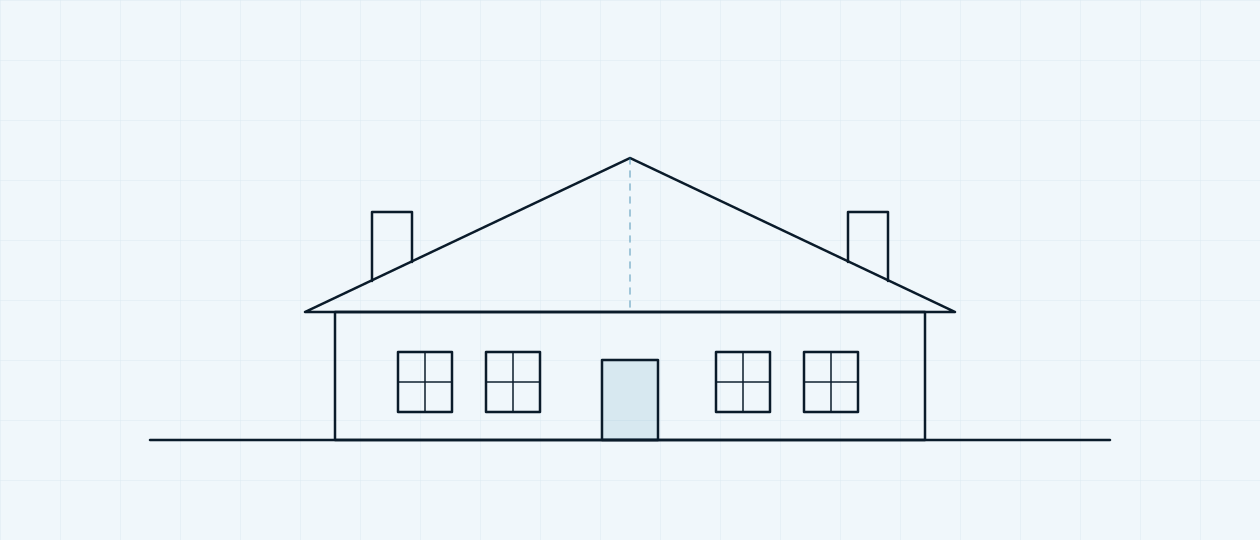
Extending a Cottage
From an architectural point of view, cottages are a wonderful way to connect with rural houses steeped in our history and heritage. There are countless examples scattered along our country roads. Sadly, many are in poor condition, left idle and neglected for long periods, and in many cases deemed unable to adapt to modern living.
Over the last few years, though, my experience has shown that people's perceptions are changing. People are starting to see the wonderful potential many cottages have. I greatly admire anyone who takes on the renovation and extension of these iconic pieces of our history. For many it's a labour of love, and although it can be draining, both financially and emotionally, the rewards far outweigh the sacrifices.
There are several things to consider when designing a cottage extension, but one matters above all: don't turn your cottage into a sprawling castle. A lot of people make the mistake of building large, oversized, out-of-scale extensions. That loses the style, character and history of the cottage, the very things that attracted you to it. It also risks leaving the internal layout and rooms unbalanced and out of proportion with the original.
Many old cottages don't suit modern living, so changes to the layout and the distribution of rooms are inevitable. To extend a cottage successfully you need a good understanding of how the internal space works, a respect for the age and history of the property, the right scale both inside and out, and great care with your choice of materials.
Design tips
Engage a consultant who can advise you on designing an extension that won't detract from the proportions or features of the existing cottage. Where possible, maintain the rhythm and flow of the existing architecture. That doesn't mean you have to replicate the style or materials, or that you can't put your own modern stamp on it. Many cottages are beautiful precisely because of the extensions added to them.
One approach is to create a link between the old and the new. This gives a clear distinction between cottage and extension, which works well if you want a modern extension. The link could be built around a courtyard, a great way to let in natural light. It also saves you making serious alterations to thick existing stone walls, which can be very costly.
Bear in mind that traditional materials behave differently to modern products. Cement, for example, if used incorrectly, can cause damp and other problems. Issues can also occur in the foundations. When a new extension with deep foundations is attached to an old building with shallow foundations, it can cause settlement. So if you're using a link between the cottage and the extension, it needs to allow for movement between the two.
If you're considering extending or renovating an old cottage, consult a professional who can guide you through the process and advise on whether planning permission is required. They can also check whether the building is listed, and advise on any grants you may be able to access.
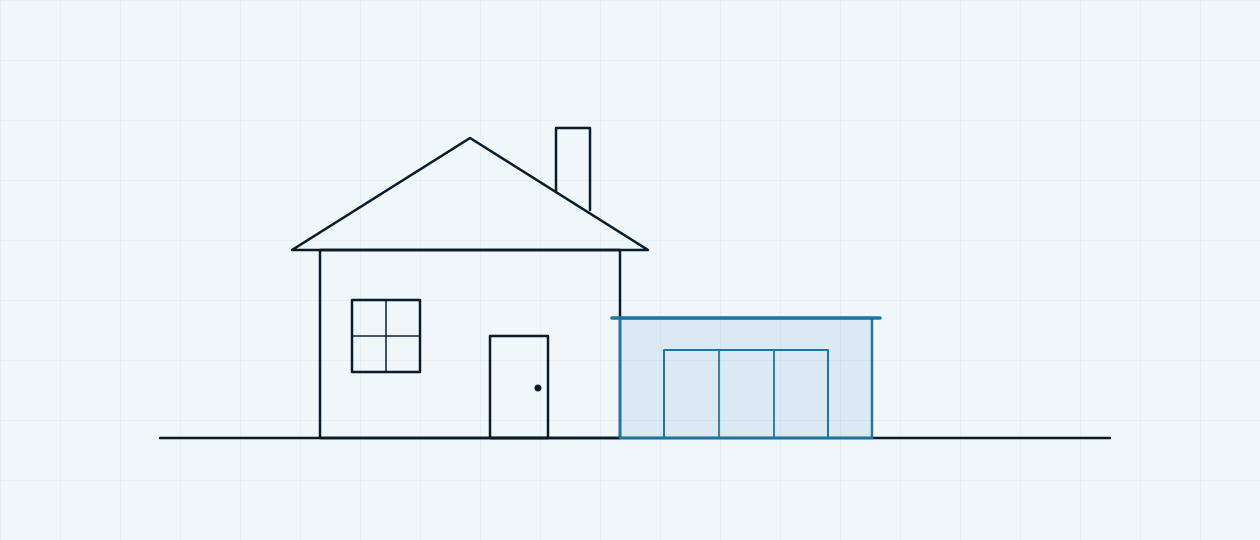
Extensions: What's Required?
There are several reasons you might extend your home. You want to give it a makeover. It doesn't suit your current needs. You need more space. You want to add value. Or you simply want to stamp your own look and style on it. An extension can have a great impact on your lifestyle and help you fall in love with your home again.
During the housing boom of the early 2000s, many people bought starter homes, a foot on the property ladder, without really planning how they'd grow into them. The crash, and the falling value of homes, forced people to re-evaluate their plans for their houses.
There are several key factors to consider when starting an extension.
Why?
Establish your motivations for extending. Is it extra space? Extra bedrooms, a larger kitchen and living space, more storage? Once you understand why you're extending, it helps you stay focused during design and stops you stretching yourself financially on unnecessary, oversized work.
Make a list of the things you don't like about your house, a list of the things you do like, and picture how you want to live in it. This matters, because it makes sure the investment you're about to make results in an extension that truly reflects your present and future needs.
Your existing house
Be aware of the potential your house already has. A consultant can unlock the hidden gems in your home, that's their job, to show you something you hadn't considered. It's common for people to build over-the-top extensions when, if they'd spent more time exploring their existing house, changing the layout and sizes of rooms, they'd have needed only a small extension, or none at all.
Know the limitations of your house too. Some people have unrealistic expectations about what they can build, whether on budget, on space, or on what the council will permit. An experienced consultant should identify these issues and guide you through them.
Your neighbours
While your extension should reflect your taste and needs, neighbouring houses should also be considered. Make an effort to ensure any extension blends in with the surrounding houses. If you're proposing something completely different to the architectural style of the area, you'll have to show how it's successfully separated from the neighbouring dwellings.
When the design is done, show it to your neighbours. They'll appreciate the courtesy, and it gives you the chance to ease any concerns they may have.
Your construction budget
An extension can actually cost more per square metre than a new build. There are reasons for this. The upgrade of the existing house has to be factored in. Contractors often charge more because the project is smaller than a new build, and so worth less to them.
Setting a budget is where many people fall down, usually by underestimating the time and money required. When setting yours, account for the possibility that you'll need to move out during construction, so funds for renting elsewhere. Set aside 10% of the overall construction budget as a contingency, so you're ready if any nasty surprises crop up. Account for planning application fees if they're required. And set aside funds for new furniture once construction is finished.
Design process
An extension is your opportunity to address the issues you have with your house, put your own mark on it, and make it truly reflect you and your family. But you must not do it to the detriment of the existing house.
A common mistake is to design and build a beautifully spacious extension while ignoring the existing house. That can leave the old areas deprived of natural light. It's all well and good having a great new kitchen or living room, but if you're not using the rest of the house, you're not much better off.
When designing your extension, I'd encourage you to change the way you live in your house. Don't be afraid to make bold decisions, changing the location of your kitchen, your living room, even your stairs. Studying the layout of your existing home to see how it could be improved will result in a more cost-efficient extension, and you may find you don't need the big extension you first considered.
Keep the look and feel of your existing house in mind. Match the most prominent features, the roof of the house to the roof of the extension, and use existing materials where possible for a sense of continuity. Explore every possibility with your consultant. By choosing to extend, you're more than likely making a commitment to settling in your house long-term.
Remember, you're the boss
Throughout the project you may have to deal with a lot of trades people and specialists. If you're not used to that environment, a consultant can guide you through it. But don't forget, this is your home and your money. Don't be afraid to make changes or question things. If you're not happy about something, speak up. Don't rely on other people to propose changes, if you feel the design can be improved, go for it. The worst thing that can happen is regret once the extension is complete. Take ownership of it. With the right team around you, it can be a very rewarding experience.
Items to Consider When Buying a Site
Over the years I've lost count of the sites I've viewed with clients, sites they'd set their hearts on, only to advise them to find another. There can be many reasons, but the main ones are:
- Planning permission cannot be obtained
- The site is too small to accommodate all the required services
- The sight lines are not available
- The site failed a percolation test
When viewing a site with a vendor or estate agent, do whatever research you can and arrive armed with the right questions. Too often people ask only the basic questions, pay a deposit, then hire an architect or engineer to survey the site and apply for planning, only to be told permission cannot be obtained, after they've already lost money and time.
First, find out how the site is zoned
Around the country, areas are placed into zones, from urbanised areas to strong agricultural areas. These zones set out the criteria an applicant must meet to apply for planning permission. Some require the applicant to demonstrate they're from the area, or to demonstrate why they need to live there, through birth certs, work statements and so on.
If there's an old dwelling on the site, check whether it's listed or of any historical importance to the council. If it is, you'll be restricted in what you can build. If it isn't, you can apply for permission to knock it and build a new dwelling. Worth noting: if you find a site with a house on it that can be knocked, the zoning criteria do not apply, in other words, anyone can apply for planning permission without meeting the criteria that would normally apply.
Check the sight lines
One of the first things I do when viewing a site is go out onto the road and check for an existing entrance. If there is one, I measure sight line distanceto confirm metres in either direction to make sure there's full visibility for cars coming out of the site. This is one of the conditions a council will impose. If there's no existing entrance, I look for the most suitable location for one.
The sight line distance has been left as a placeholder on purpose. The figure quoted on the previous site needs to be confirmed against current standards before this page goes live.
Poor sight lines are a common reason planning applications are refused. Many people are left with the costly work of removing bends in the road to achieve them.
Are there site services?
Check whether there's water on the site and drainage in the area. Many rural sites have no drainage, so a site suitability test would be required, where an approved engineer carries out a series of drainage tests to confirm the site can be adequately drained. If the site fails this test, planning permission will not be granted. This is common, so make sure any site you're considering has the potential to take the required services.
The site itself
When viewing, factors like whether the site is elevated, its orientation, trees around it, overhead power lines, all affect the type of house you can build. If the site is elevated, the council might not favour a large two-storey house on top of the hill, or they may want it screened with trees, which can be costly. If you want the house facing a certain direction, look at the neighbouring dwellings, the precedent they set may be something you have to follow. The same applies to house type. If you want a large two-storey but there are only bungalows and dormers around you, it can be very difficult to get the house you want.
Future development
Buying a site and building your home is one of the biggest undertakings anyone can take on, so safeguard it. Check whether there are any planning applications lodged with the council on neighbouring sites, this could lead to you being overlooked. Visit your local county council office and check the county development plan to see what future plans the council has for the area, schools, shopping centres and so on that could be built beside you.
Most of this information is easily available from your local council office. Just make sure you know the right questions to ask and the things to look out for.
Still have questions?
Every site, every house and every budget is different. The fastest way to a clear answer is a free consultation, on your site, anywhere in Ireland, with no obligation.
Book a free consultation→